

A Scientific Masterclass on Surviving the Great Freeze of 2026
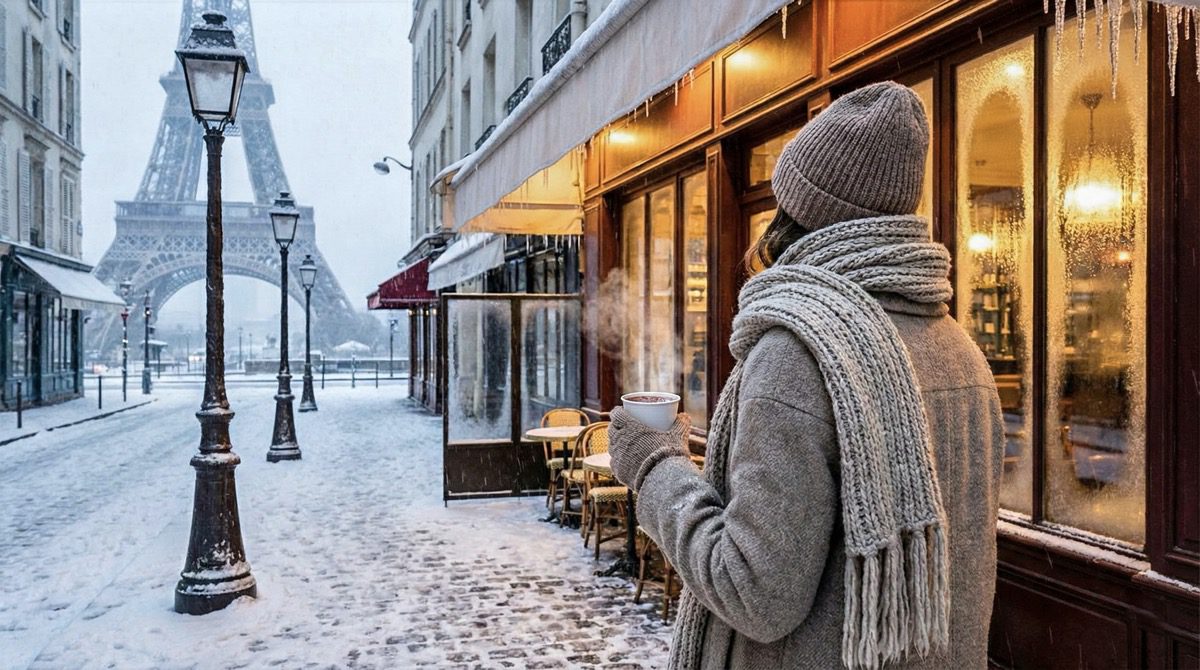
In the opening weeks of 2026, the European continent has found itself locked in a crystalline grip. From the frozen banks of the Seine to the snow-heavy forests of the Jura, this is not merely a seasonal shift but a profound confrontation with a changing climate. As temperatures plummet to levels not seen in a generation, the challenge we face is twofold: understanding the chaotic atmospheric engines that drive these extremes and mastering the internal biological mechanisms that allow us to withstand them. We are no longer passive observers of the cold; we are entering an era of managed adaptation, where thermodynamics becomes our primary tool for resilience.
The Atmospheric Engine: Rossby Waves and the Omega Block
To understand the winter of 2026, one must first look toward the tropopause, more than 10 kilometers above the earth. This is the realm of the jet stream, the high-velocity ribbon of wind that separates polar air from subtropical warmth. However, due to the accelerated warming of the Arctic—a phenomenon known as polar amplification—this atmospheric engine has slowed, creating capricious meanders called Rossby waves.
When these waves become stationary, they create blocking patterns. The famous Omega Block, characterized by its central high pressure, acts as a fortress of thermal inversion, trapping freezing air and urban pollution at ground level for weeks. Simultaneously, the Rex Block, a North-South dipole, splits the jet stream and freezes weather systems in place, causing chronic flooding where snow was expected. These configurations are no longer anomalies; they are the structural pillars of a new climatic normalcy.
The Biological Furnace: The "Brown Fat" Revolution
While the atmosphere dictates external conditions, the true battle for homeostasis is fought within our cells. Science has moved beyond viewing body fat as a monolithic enemy, focusing instead on the bio-hackable potential of Brown Adipose Tissue, or BAT. Unlike white fat, which merely stores calories, brown fat burns them to generate heat.
At the heart of BAT lies the protein UCP1 (Uncoupling Protein 1). In a remarkable feat of biological engineering, UCP1 short-circuits the usual process of chemical energy production, diverting it instead to generate pure heat. To recruit and activate this internal heater, the 2026 Cold-Acclimatation Protocol suggests maintaining living spaces at 17°C to 19°C to trigger non-shivering thermogenesis. Further stimulation can be achieved through thermal contrast, such as ending a shower with 30 to 60 seconds of cold water on the neck and shoulders to activate TRPM8 receptors, or through controlled outdoor immersion to increase mitochondrial density.
Molecular Nutrition: Fueling the Mitochondrial Fire
To sustain this internal combustion, your body requires more than just calories; it requires a precise molecular fuel strategy. In 2026, we view nutrition as the signal that manages our internal thermostat. The electron transport chain in your mitochondria relies on iron-containing proteins called cytochromes. Without sufficient iron, your internal furnace lacks the bellows to burn oxygen. While liposomal iron supplements are a staple of modern biohacking, their efficacy is predicated on maintaining a stable Selenium-Iodine axis.
Your thyroid serves as the master thermostat, and the conversion of the hormone T4 into its active form, T3, is catalyzed by enzymes containing selenium. Pairing this with iodine ensures that your metabolic rate does not collapse in the cold. Furthermore, magnesium acts as the vital currency for all energy transactions, while Omega-3 fatty acids ensure that mitochondrial membranes remain fluid and functional even as peripheral temperatures drop.
| Step | Action | Duration / Temperature | Expected Benefit |
|---|---|---|---|
| 1. Ambient Exposure | Maintain living spaces at a cool temperature. | 17°C - 19°C | Basal activation of UCP1 without shivering. |
| 2. Thermal Contrast | End shower with a cold water jet on the neck and shoulders. | 30 - 60 seconds | Stimulation of TRPM8 receptors (cold detection). |
| 3. Controlled Immersion | Outdoor walking with one less layer of clothing. | 20 minutes / < 10°C | Increase in mitochondrial density and cell recruitment. |
Defensive Sentinels and the Alcohol Mirage
Why do we fall ill more often in the deep freeze? Modern research has identified the nasal sentinel as a primary factor. Our nasal mucosa releases extracellular vesicles, which are biological decoys that capture viruses before they infect our cells. However, a drop of just 5°C in the nasal cavity reduces this vesicle production by nearly half. The cold does not create the virus, but it effectively disarms our primary defense.
To compensate, many turn to Vitamin C, but caution is vital. Intakes exceeding 1,000 mg per day are frequently converted to oxalate, increasing the risk of kidney stones. While specialized Vitamin C formulations are widely available, natural citrates from whole fruits remain the superior biological choice. Furthermore, we must dispel the alcohol mirage. Alcohol is a potent vasodilator. By forcing warm blood to the surface of the skin, it provides a fleeting sensation of heat while the core temperature silently collapses, effectively opening the thermal floodgates of your body.
The Thermodynamics of Fashion: "The Three Necks"
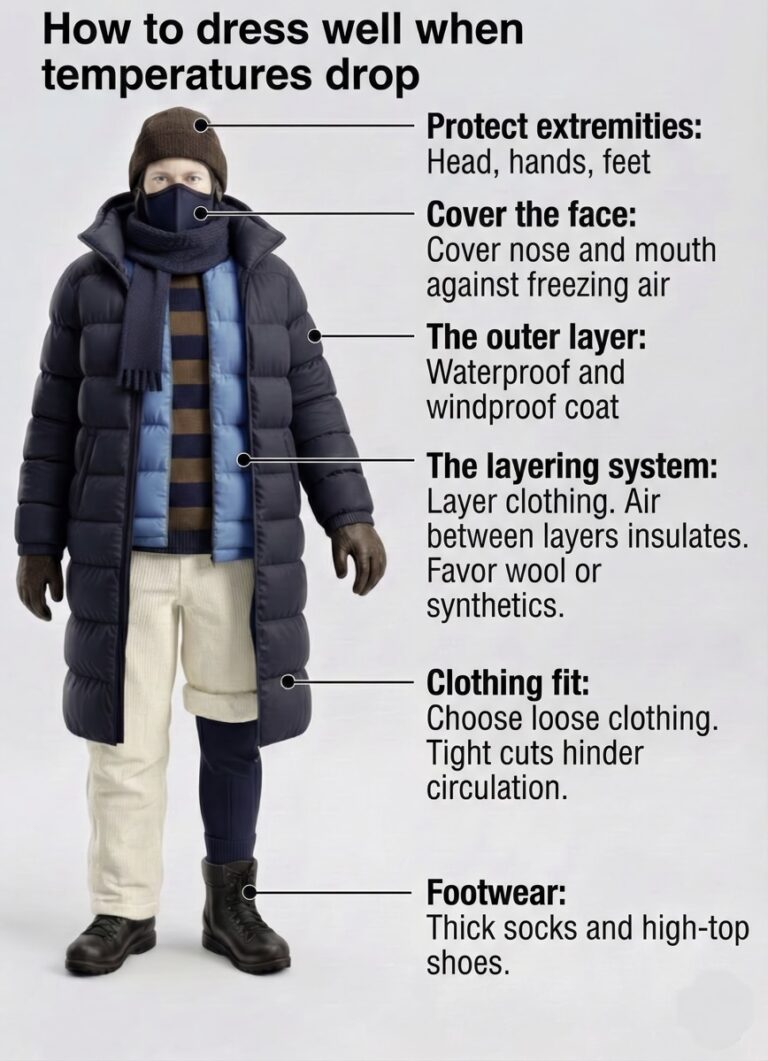
Finally, we must view clothing as a system of thermal management. The secret to warmth is not the fabric, but the stationary air it traps.
The Three-Layer Philosophy
Base Layer (The Dry Imperative): Avoid cotton, which becomes a “wet rag” that drains heat. Use Merino wool, which releases heat through exothermic sorption as it absorbs moisture.
Mid Layer (The Shield): Fleece or light down to trap warm air.
Outer Layer (The Barrier): Breathable membranes like Gore-Tex to block wind while allowing internal moisture to escape.
To prevent heat from escaping like a chimney, you must seal the “Three Necks”: the actual neck, the wrists, and the ankles. These are areas where blood vessels pass close to the surface. Covering them, along with using a scarf to pre-warm the air entering your lungs, is a metabolic survival imperative.
Toward a Mastered Winter
In 2026, we no longer simply endure the winter. By understanding the geophysics of the jet stream, optimizing our molecular nutrition, and applying the laws of thermodynamics to our habits, we transform a season of vulnerability into one of biological excellence. We are not just surviving the cold; we are mastering it.
Hello. It is cold outside these days, so I hope you are staying warm and keeping healthy. For a long time now, French winters have been mild because of global warming, but it feels like a real winter has finally returned. Still, I remember the winters of the past being much harsher. Decades ago in Paris, the roads were frozen solid every morning. Since the sun does not rise until nearly quarter to nine in December, most people left for work in total darkness. Many wore heavy snow boots for the commute to avoid slipping, then swapped them for high heels at the entrance to the Metro. These days, you hardly see anyone in snow boots. It seems the cold is still manageable with regular shoes. The real problem is how long the season lasts. When the temperature first drops, you are careful to protect yourself, but once you get used to the chill, you start to think your normal routine is fine. That is when you let your guard down. You slip on an icy patch, or you catch the flu. If you go out drinking and wander the streets, the cold can become a matter of life and death. I have never been a fan of the cold, but I do enjoy the feel of extremely dry, freezing air. Sometimes I go for a walk in that biting atmosphere on purpose. I do not go so far as to jog, but I like to walk up and down stairs until I am slightly out of breath. My circulation improves and my body starts to glow with a pleasant warmth. It feels a bit like a portable sauna. Back when I lived in Canada, the temperature would sometimes drop to thirty degrees below zero. At that level of cold, it felt as though no viruses or bacteria could possibly survive. The air was incredibly pure. It was an extreme cold, of course. People often go to the mountains and talk about how fresh the air is, but I think the air in the deep freeze of winter is the cleanest of all. Just breathing it made my lungs feel cold and sharp, which probably was not very good for me, but it felt wonderful. I can only say such things because I have a warm place to go. For the many homeless people in Paris, the situation is much more serious. On nights when the temperature drops below freezing, volunteers try to take them to shelters, but many of them refuse. Often, they have chosen life on the street because they struggle with social rules or being around others. Even a warm shelter can feel unbearable to them if it means sharing a room. To make matters worse, when they do get a little money, they often buy alcohol instead of food. Every morning the news carries the sad story of someone who fell asleep and never woke up. I find myself wondering how we can save their lives without taking away their sense of freedom. I had an idea for a high-tech version of those long bench coats you see rugby players wearing. It would be a hybrid of a coat and a blanket. The inside would be lined with soft, warm fleece, and it would have a hood that covers the head completely. The outside would be made of a weather-proof material that blocks the wind and rain. If you could extend the bottom part, it would turn into a sleeping bag. With today’s textile technology, it should be possible to create a “wearable bed” that works as a coat during the day and a place to sleep at night. If someone made a coat like that, I would probably be the first person to buy one. When it comes to keeping your face warm, nothing beats a cagoule. It is a hood and a scarf joined together. Once you get used to how easy and warm they are, you cannot live without them. They come in many styles, but the most effective one covers the entire face. It looks a bit like a winter version of a professional wrestler’s mask. I actually own one myself, and it is so warm that I feel like I could go anywhere. The only downside is that it makes me look like a bank robber. People tend to look startled when they see me. I wish someone would design a cagoule that says “I am not a robber” on it, or perhaps one that looks so harmless that no one could possibly be afraid. Many people avoid the best masks because they do not want to be mistaken for a criminal, so I am sure there is a real demand for a friendlier design.