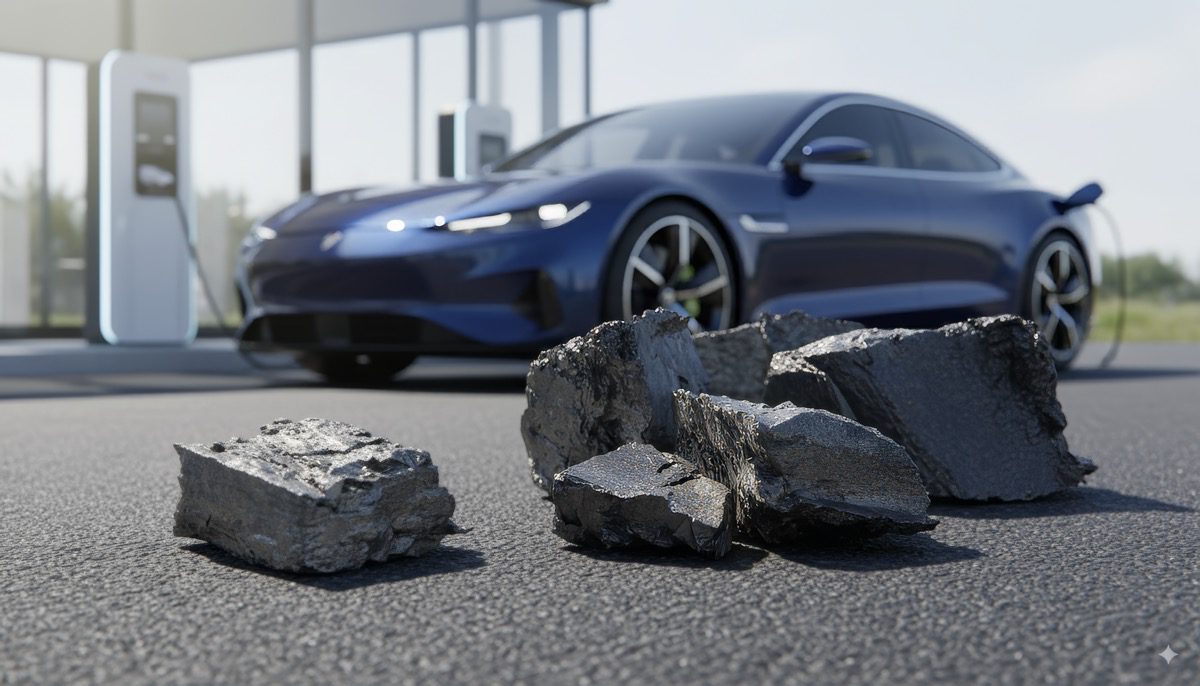
In the quiet acceleration of an electric vehicle or the haptic vibration of a smartphone, a group of seventeen elements—the Rare Earth Elements (REEs)—is performing a silent, industrial miracle. Often called the “vitamins of modern technology,” these minerals are the bedrock of the 21st-century economy. However, as we move through January 2026, the “rare” in their name has become a strategic irony. These elements are not actually rare in the Earth’s crust; cerium is as abundant as copper. Their true rarity lies in the harrowing difficulty of their extraction and the toxic legacy of their refinement.
For decades, the global supply chain was built on a dangerous convenience. Rare earth minerals, such as neodymium and dysprosium, are almost never found in concentrated veins. Instead, they are dispersed within host ores like monazite, which often coexist with radioactive elements like thorium and uranium. To isolate a single kilogram of refined rare earth oxide, one must process tons of ore through hundreds of chemical baths using concentrated acids. This process generates massive volumes of toxic sludge and radioactive wastewater, making it a nightmare for nations with strict environmental protections.
A common misconception is that the rest of the world stopped mining rare earths simply because China had more. The reality is far more unsettling. In the 1990s and early 2000s, Western nations—including the United States, which once led the market—essentially outsourced the pollution. This was a period of “Environmental Arbitrage.” China, under a strategic mandate to dominate the sector, was willing to accept the environmental degradation that Western regulators would not.
By allowing looser disposal standards for radioactive thorium byproducts, Chinese refineries could underprice any global competitor. This created a profound structural dependency. Even when other countries began mining again, they found themselves trapped in a midstream bottleneck. As of 2026, while mining has diversified to Australia, Vietnam, and Brazil, China still controls nearly 90% of the global refining and separation capacity. Without the specialized chemical knowledge to separate these chemically identical elements safely, the world remains tethered to a single source.
As of early 2026, the geopolitical landscape has shifted from passive concern to aggressive strategic autonomy. The European Union’s Critical Raw Materials Act (CRMA) has entered a pivotal implementation phase, aiming for 25% of the EU’s annual consumption to be met by domestic recycling by 2030. In the United States, the Department of Defense has poured over €375 million into domestic processing facilities, such as the MP Materials campus in Texas, which is now beginning to produce supply chains entirely independent of foreign refining.
Despite these efforts, the market remains volatile. Neodymium-Praseodymium (NdPr) oxide, the backbone of EV magnets, is currently trading at approximately €112 per kg. While non-Chinese production is rising, it cannot keep pace with the exponential demand from the green transition. This is where Japan’s unique reverse thinking is proving to be the ultimate game-changer.
While the rest of the world scrambles to build new, cleaner chemical refineries—a process that takes over a decade—Japan has looked toward the furnace. A landmark collaboration between Nissan Motor and Waseda University has perfected a pyrometallurgical recycling process that bypasses the traditional, toxic chemical baths.
Historically, recycling magnets from EV motors was an economic failure. It required manual disassembly and hours of thermal demagnetization to remove the magnets from the steel rotors. The Nissan-Waseda method is elegantly brutal: they melt the entire motor whole. By heating the motor to over 1400°C and adding a borate-based flux, the rare earths naturally oxidize and float to the surface as a slag, while the iron and copper sink as a heavy alloy. This method achieves a 98% recovery rate of rare earth elements in half the time of traditional methods. By 2026, this urban mining is becoming a strategic reserve, turning end-of-life EVs into a self-sustaining resource loop.
In the current market of January 2026, the price of virgin Neodymium-Praseodymium (NdPr) oxide fluctuates around €112 per kg. Traditional recycling, hindered by labor-intensive disassembly, often costs upwards of €150 per kg, making it a subsidized charity rather than a viable business.
However, the Nissan-Waseda pyrometallurgical approach changes the calculus. By eliminating the manual disassembly phase—which accounts for nearly 50% of traditional recycling costs—the operational expenditure (OpEx) is slashed. While the energy cost of maintaining a 1400°C furnace is significant, it is offset by the sale of the high-purity iron and copper byproducts recovered simultaneously. In 2026, analysts estimate this process can produce recycled rare earth concentrates at approximately €85 per kg, finally achieving price parity with—or even undercutting—newly mined materials from overseas.
Europe has responded to these Japanese breakthroughs not just with interest, but with legislative embrace. The EU Battery Regulation, which reached a critical enforcement milestone in late 2025, now mandates a “Digital Product Passport” for every EV battery and motor sold in the Union. This passport tracks the origin of materials, and by 2031, will require a minimum percentage of recycled rare earths in all new permanent magnets.
Furthermore, the Critical Raw Materials Act (CRMA) sets a target for 25% of the EU’s annual consumption of strategic raw materials to come from domestic recycling by 2030. European automakers like Volkswagen and Renault are reportedly in high-level talks with Nissan to license the pyrometallurgical technology. For Europe, the Japanese “melt-whole” method is the “silver bullet” that allows them to meet strict environmental targets without needing to build hundreds of new chemical tailing ponds on European soil.
The second prong of Japan’s strategy is even more radical: designing the elements out of existence. The most sensitive material is Dysprosium, a heavy rare earth added to magnets so they do not lose strength at high temperatures. To break this link, Japanese engineers have attacked the problem of heat itself.
Nextcore Technologies, a Kyoto-based innovator, has commercialized “Helmet,” a metallic ribbon just 0.03 mm thick. By drastically reducing eddy current losses—the internal friction that causes motors to heat up—the “Helmet” keeps motors so cool that the need for heat-resistant dysprosium is neutralized. Simultaneously, Nissan has expanded the use of its Electrically Excited Synchronous Motors (EESM), which use electrified copper coils instead of permanent magnets. 2026-era Japanese engineering has refined these designs to match the power density of magnet-based rivals, proving that the best way to win a resource war is to stop needing the resource.
The significance of these breakthroughs transcends the automotive sector. They represent a fundamental shift in how we define economic power. For the last century, power was defined by who owned the land and the mines. In the next century, power will be defined by who owns the circularity—the ability to reuse, refine, and redesign.
By perfecting the ability to melt and separate waste and the ability to design out scarce materials, Japan is insulating its industrial heart from the whims of geopolitical rivals. In the 2026 landscape, the bottleneck is no longer a dead end; it is an invitation to invent a more resilient, cleaner, and truly autonomous future.