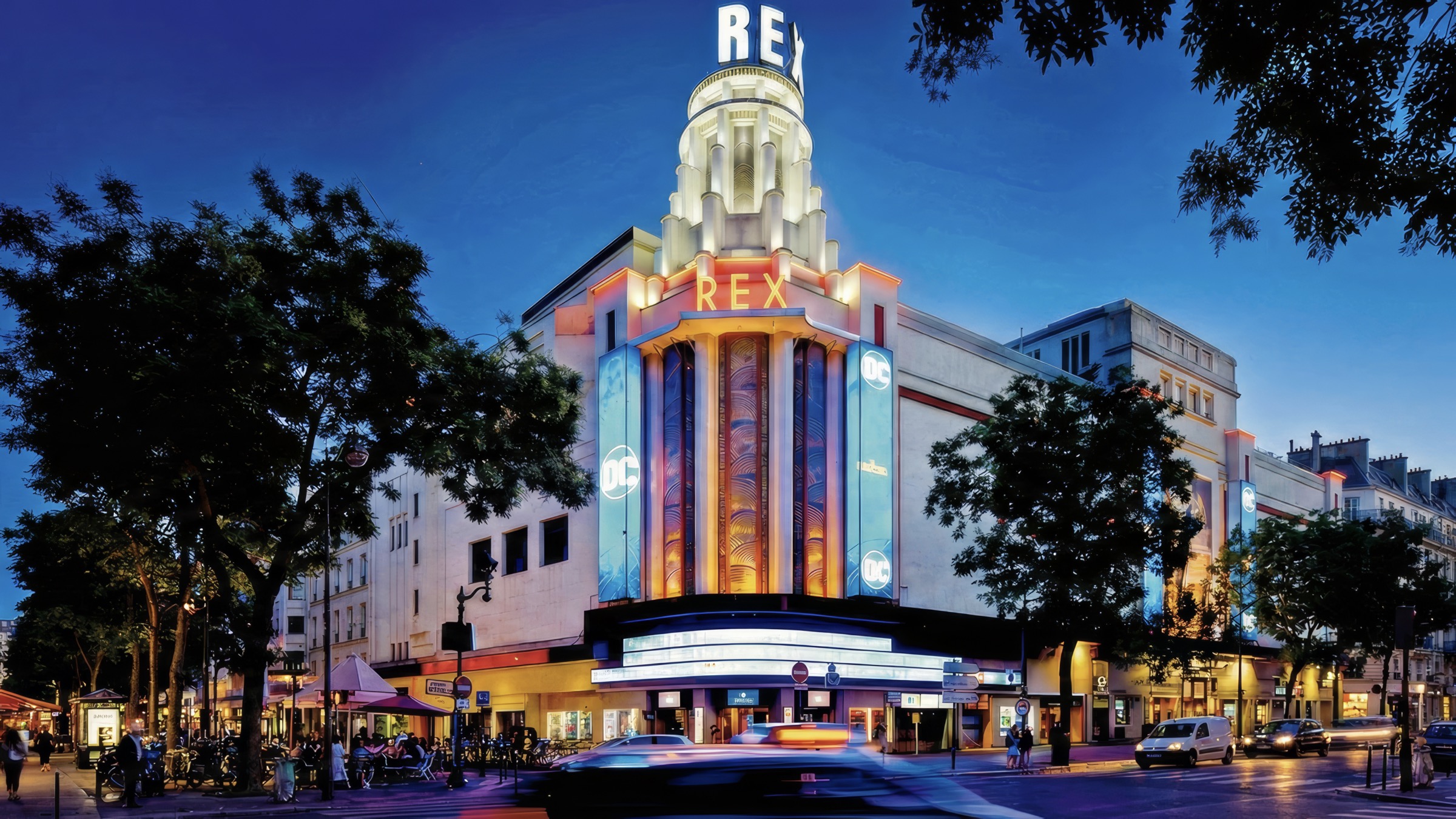
In the labyrinthine streets of Paris, one often encounters buildings that command a sudden and inexplicable pause. They lack flamboyant gilding, yet they possess an undeniable magnetic pull. Their lines are sharp and uncompromising; nevertheless, they feel strangely warm. Though they belong to a century long past, they appear more modern than many contemporary glass towers.
This is the enduring sorcery of Art Deco.
Often dismissed as a mere decorative trend, Art Deco was in reality a profound intellectual project. It represented the story of how a fractured society, emerging from the ruins of the Great War, attempted to redesign the very concept of beauty for a new era. Paris served as the primary laboratory for this experiment. In 2026, as we mark a century since its official birth, our fascination with Art Deco transcends mere retro-chic. We are drawn to it because the 1920s, an era of dizzying technological leaps shadowed by deep social anxiety, mirrors our own current zeitgeist with startling precision.
Art Deco Was a Philosophy Rather Than Decoration
Art Deco was born in a Paris reeling from the immediate aftermath of World War I. The city was wounded and yearning for progress, yet its citizens felt a powerful desire to never repeat the chaos of the past.
Before the war, Art Nouveau reigned supreme. It was a style characterized by whiplash curves, organic vines, and a dreamlike sensuality inspired by the vitality of nature. However, for a post-war society, those undulating lines began to feel unstable and evocative of a bygone era.
Enter Art Deco, which acted as a manifesto of straight lines, geometry, and symmetry. It prioritized structure over emotion and the urban grid over the wild forest. It was the beauty of order designed to reassemble a broken world. Crucially, this was not just a passing fashion in decor. It was a visual answer to the fundamental questions of how to live and what kind of future to believe in.
The Great Divide: Art Nouveau vs. Art Deco
To understand the shift, one must look at the fundamental DNA of these two styles.
| Feature | Art Nouveau | Art Deco |
|---|---|---|
| Era | 1890s to 1914 (Pre-WWI) | 1920s to 1930s (Interwar) |
| Core Ethos | Organic, fluid, artisanal | Geometric, rational, industrial |
| Key Motifs | Flowers, insects, flowing hair | Triangles, zigzags, skyscrapers |
| Materials | Wrought iron, glass, wood | Chrome, steel, concrete, lacquer |
Characteristics of Art Nouveau (The New Art)
This style attempted to fuse artisanal handwork with natural beauty in opposition to the mass-produced machine products of the Industrial Revolution.
Whiplash Curves: The most prominent feature is the undulating curve resembling a growing vine.
Asymmetry: It favors an irregular balance found in the natural world.
Representative Works:
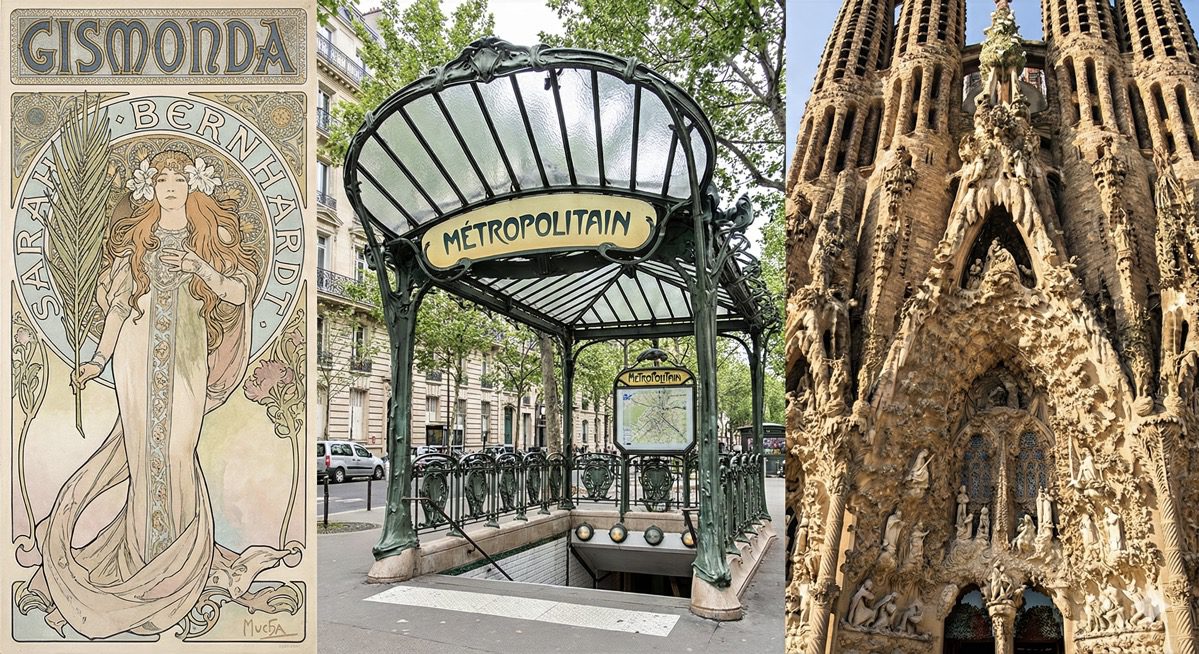
Alphonse Mucha’s Posters: Iconic depictions of women with flowing hair set against ornate botanical backgrounds.
Hector Guimard’s Metro Entrances: The ironwork resembling plant life still seen at historic Paris subway stations.
Antoni Gaudí’s Architecture: Organic structures like the Sagrada Família that consciously reject straight lines.
Characteristics of Art Deco (The Decorative Arts)
This rational and modern style emerged to adapt to a society undergoing rapid mechanization after World War I.
Geometric Patterns: Repetitive designs combining straight lines, circles, and squares.
Symmetry: Orderly arrangements that evoke a sense of discipline and stability.
New Materials: The extensive use of industrial materials such as steel, glass, plastics, and chrome plating.
Representative Works:
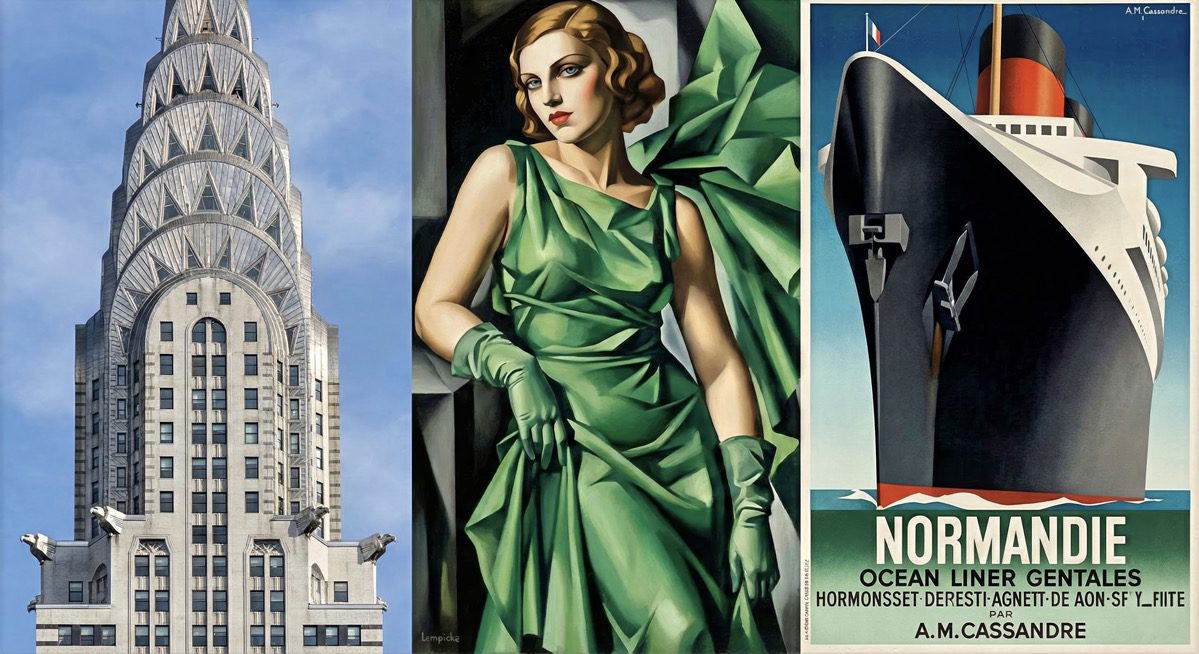
The Chrysler Building: The New York skyscraper featuring zigzag geometric motifs at its crown.
Tamara de Lempicka’s Paintings: Urban portraits of women characterized by sharp lines and bold shadows.
A.M. Cassandre’s Posters: Graphic designs that used powerful lines and geometry to depict ocean liners and locomotives.
Tips for Identification
If you find yourself in a museum or on a city street wondering which style you are looking at, ask yourself the following: “Does this look like it grew in a forest or a garden?” If the answer is yes, it is Art Nouveau. “Does it look like an urban form drawn with a ruler and a compass?” If the answer is yes, it is undoubtedly Art Deco. These two essences continue to be recycled in modern logo design and fashion today.
1925: The Day Paris Officially Declared "Modern"
The style reached its zenith during the 1925 Exposition Internationale des Arts Décoratifs et Industriels Modernes. While the name was lengthy, its content was remarkably advanced.
The event achieved what we might now call a total integration of a worldview. Architecture, interior decor, furniture, jewelry, fashion, and poster advertisements were all designed as a single life experience. The organizers believed that a modern exterior meant nothing if the furniture, clothing, and even the advertisements encountered upon entering did not share the same philosophy. This concept links directly to contemporary hotel design and brand spaces. Even a century ago, Art Deco had already reached the realization of experience design.
Paris Was a Giant Laboratory
Paris in the 1920s and 1930s served as the ideal stage for Art Deco. The widespread adoption of reinforced concrete expanded architectural possibilities instantly. There was no longer a need to hide the structural elements; instead, an era began where the structure itself became the beauty.
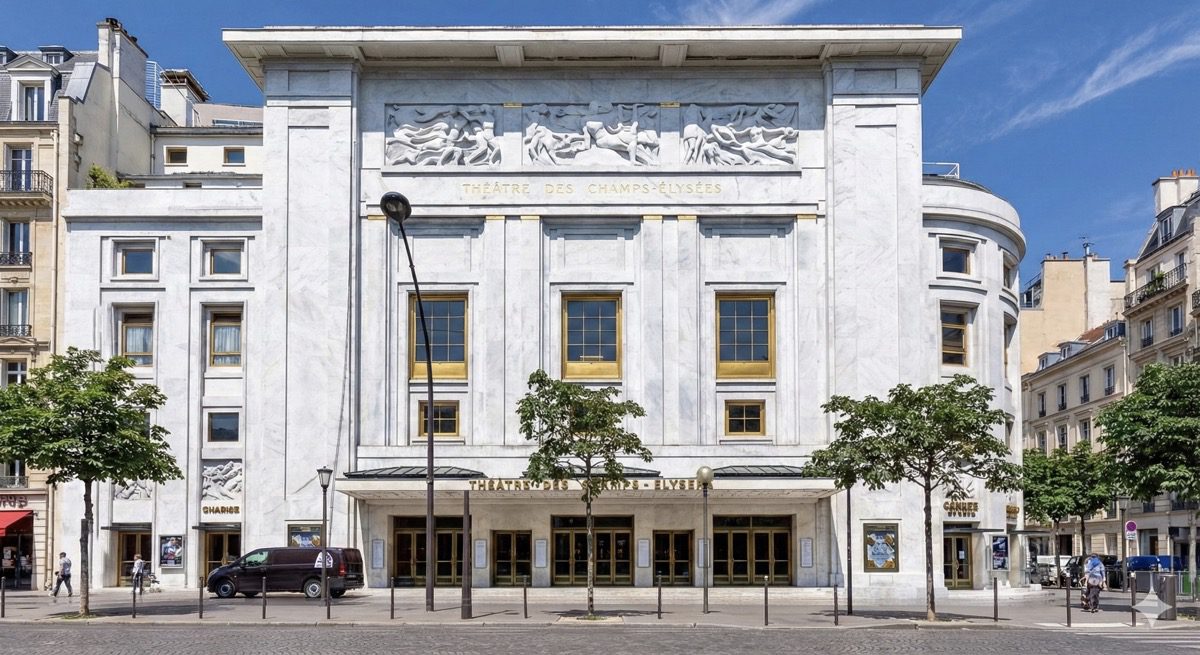
A prime symbol of this is the early Art Deco architecture found along the Champs-Élysées, The Champs-Élysées Theatre (Le Théâtre des Champs-Élysées). With bold lines and sculptural facades that rejected excessive ornamentation, these buildings stood as manifestos for the coming age. Paris was not an idealized city on a blueprint but a living city where people worked and played. Within this reality, Art Deco was forged as a beauty that was actually used and valued rather than just a theory.
Architecture Where the City Speaks for Itself
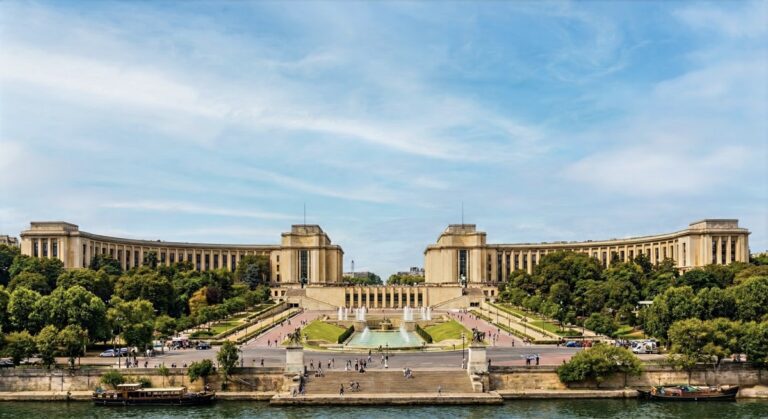
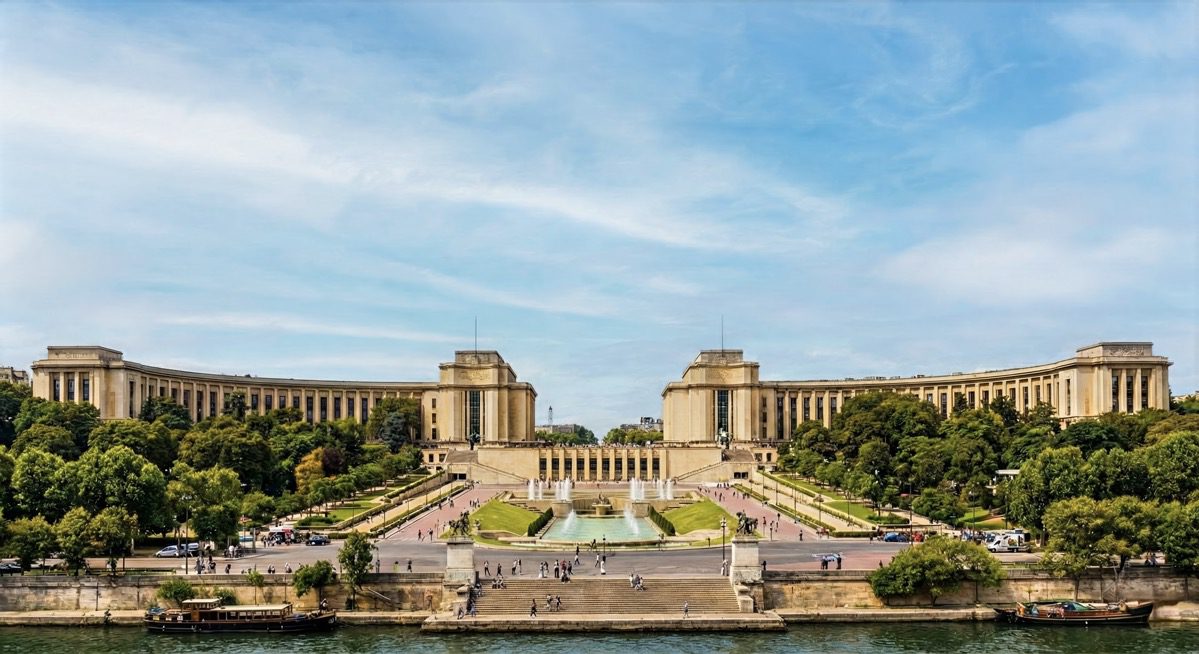
As Art Deco matured, its scale expanded beyond private residences and shops into public architecture. The Palais de Chaillot, situated directly across from the Eiffel Tower, is a representative example. Its symmetrical composition, vast terraces, and orderly colonnades make it more than a building; it is a stage set that gives form to how the city wishes to present itself.
Conversely, the Palais de la Porte Dorée reveals a different facet of the style. The reliefs covering its exterior walls speak eloquently of the imperial narratives held by France at the time. Here we see the light and shadow of Art Deco. A design that loves rationality and order also possessed the power to beautifully package national ideals and desires. Art Deco was a style that carried the weight of its era.
The Moment a Pool Becomes a Luxury Liner
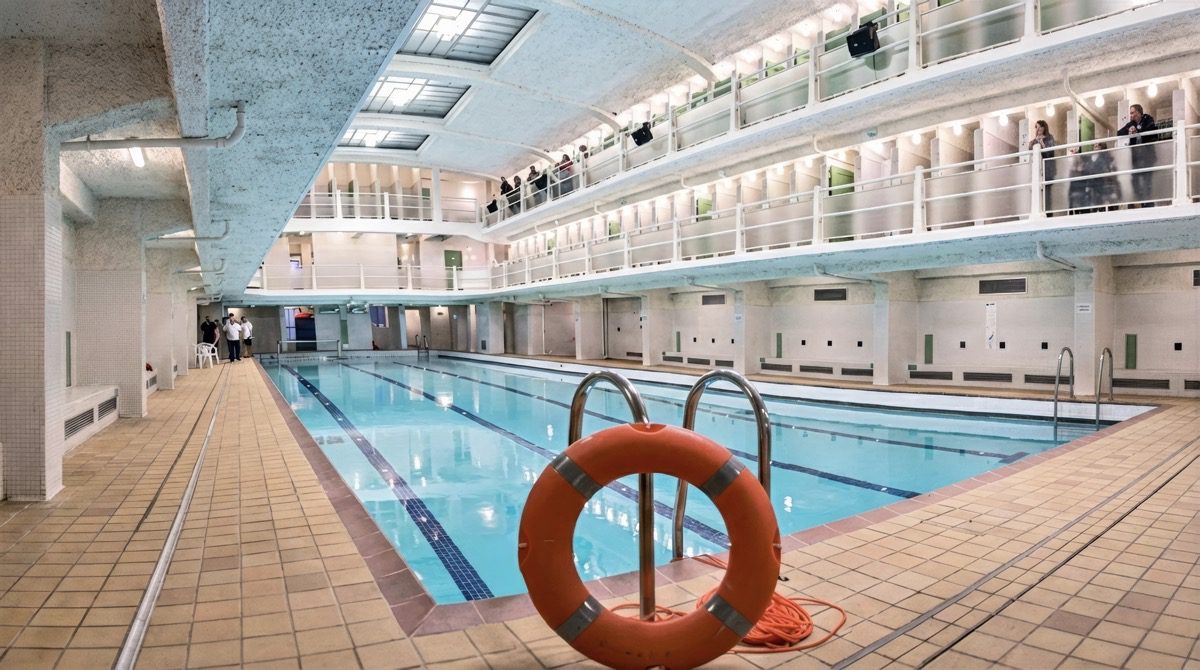
The charm of Art Deco is perhaps most visible in its use of luxury. The Amiraux Swimming Pool (Piscine des Amiraux) in Northern Paris is a perfect example. A purely functional facility like a swimming pool was designed to resemble the deck of a luxury ocean liner. With its stepped exterior, gallery-like corridors, and natural light pouring from above, utility and dreams do not conflict here. Every element serves a function while simultaneously uplifting the human spirit. Art Deco was not a style of cutting waste; it was the invention of luxury that never appeared wasteful.
The True Protagonist Was on the Inside
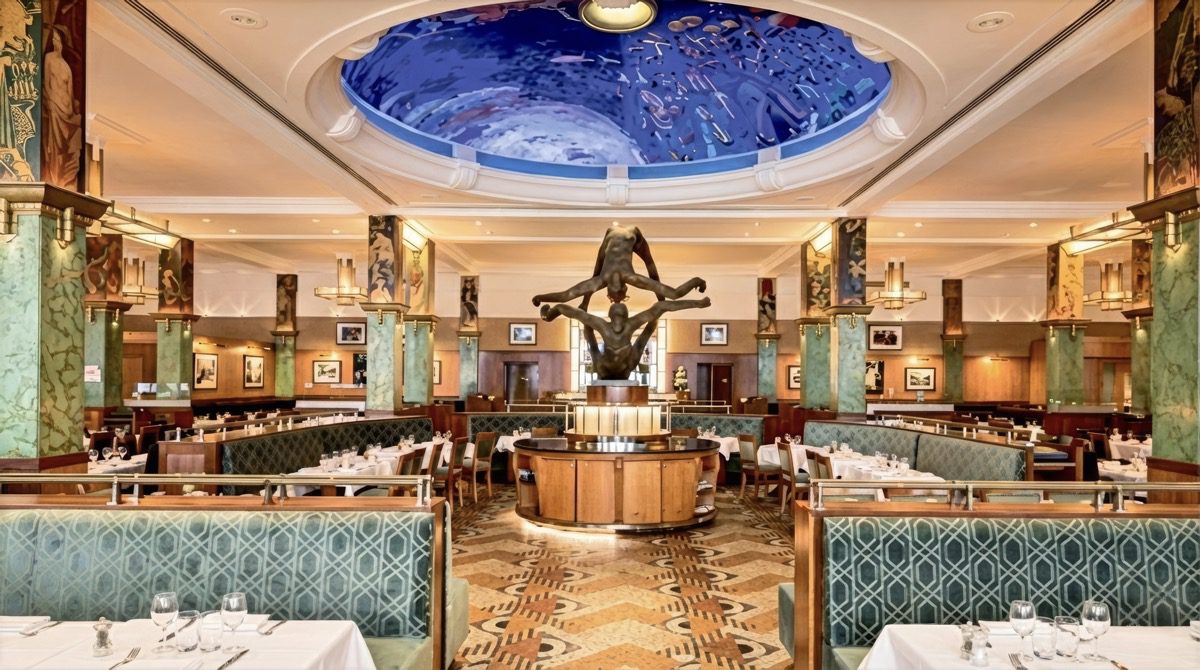
The true value of Art Deco lies in its interior spaces rather than its exteriors. Brass lines tighten the space; marble provides prestige rather than coldness; and glass makes heavy structures feel light. When lacquer and orientalist elements are added, the light gains a sense of depth.
The ultimate realization of this is La Coupole. In this brasserie founded in 1927, the pillars, lighting, and murals are all integrated into a single worldview. Dining here is not just a meal. It is an opportunity to experience exactly what Art Deco intended: the transformation of daily life into a theatrical experience.
The Style Lived Because People Were There
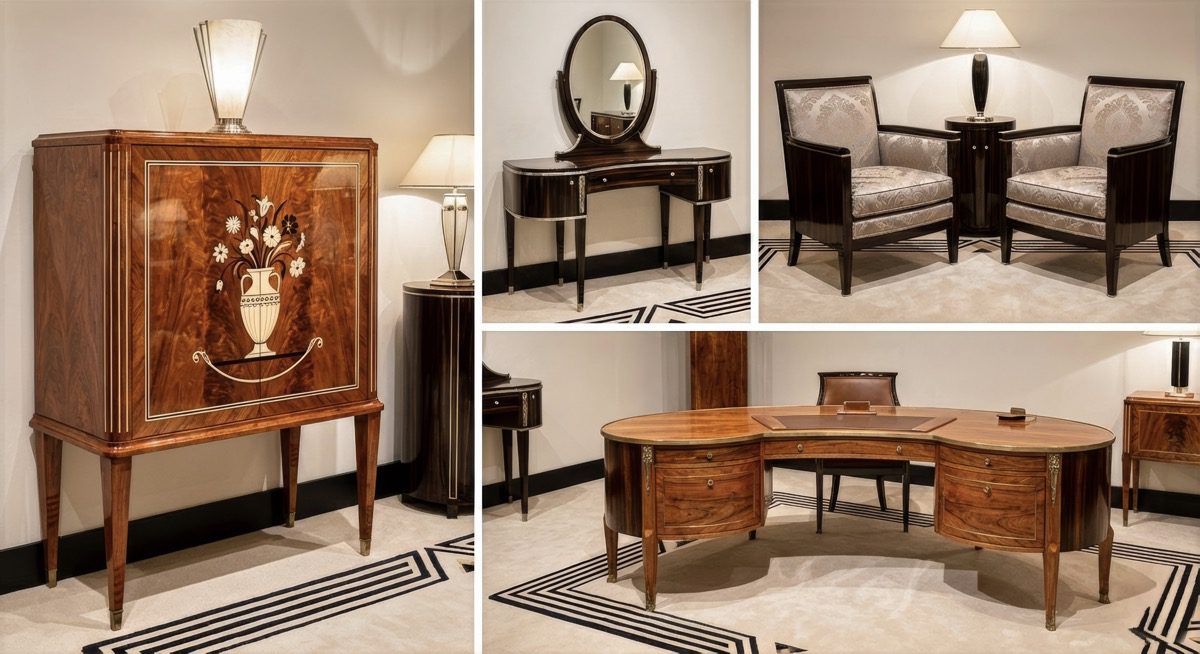
Art Deco was brought to perfection by the people who inhabited it. In the field of furniture, Jacques-Émile Ruhlmann was a pivotal figure. He used expensive materials while keeping the forms remarkably restrained, a sensibility that links directly to modern high-end interiors.
Then there was Coco Chanel. Through her use of black and white and linear silhouettes, she liberated the female body by stripping away unnecessary decoration. In her hands, Art Deco became a way of life.
Why Is It Art Deco Now?
Paris in the 1920s was intoxicated by progress yet haunted by anxiety. Technology was changing lives, movement was accelerating, and values were shifting. This sensation is startlingly similar to our contemporary world.
This is precisely why the Art Deco aesthetic, with its balance of reason and luxury and its coexistence of order and dreams, resonates so strongly with us today. Art Deco is not a finished style. It was a method of organizing beauty discovered by humans during a time of chaos. The beauty of the straight lines remaining on the street corners of Paris are the quiet traces of a people who, 100 years ago, dared to believe in the future.
À propos des images
cette composition hybride est utilisée dans le respect des lois sur le droit d’auteur. Elle regroupe des photographies originales, des images générées par intelligence artificielle ainsi que des contenus appartenant au domaine public comme Wikimedia Commons.