The Fortress in the Age of Ramparts
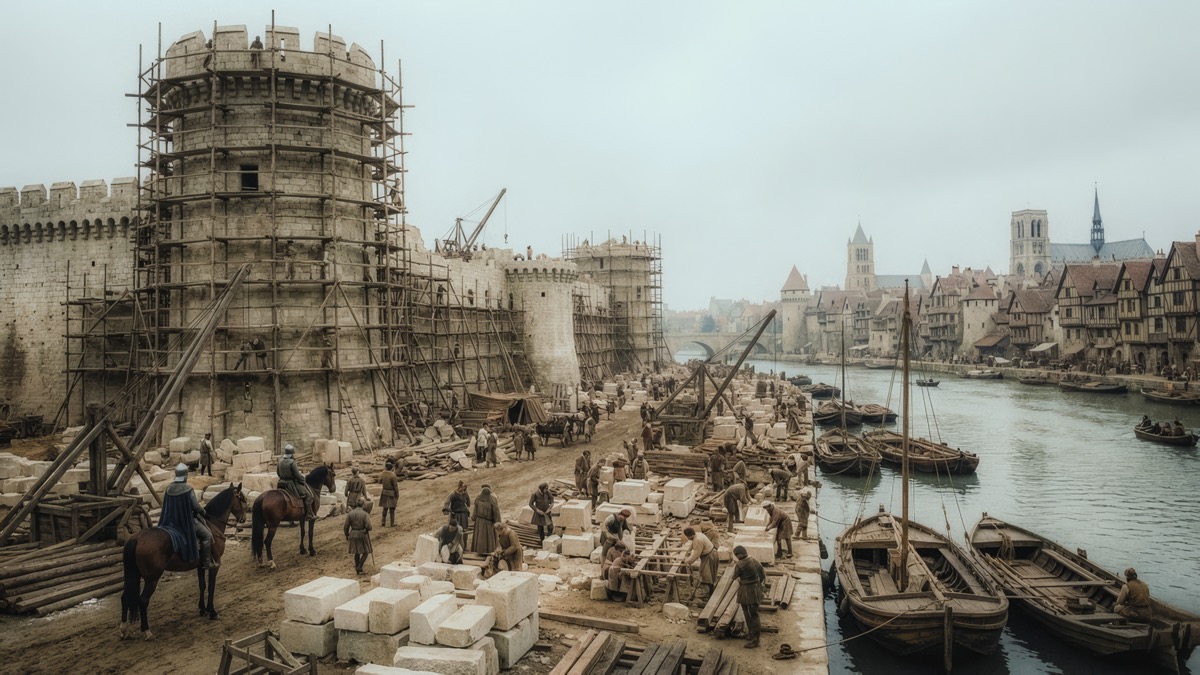
In the late twelfth century, Europe’s heartland was a tapestry of feudal power and fragile peace. As rival kingdoms squared off and dynastic ambitions rippled across the continent, one monarch saw danger approaching not just from afar but at the very gates of his capital. Philip II of France, known to history as Philip Augustus, ruled a France whose unity was far from assured. The Kingdom of England still controlled Normandy to the northwest, and native noble rebellions threatened instability at home. To safeguard Paris, Philip embarked on an ambitious defensive program.
In 1190, massive stone walls began to rise along the Seine’s right bank. These thick limestone ramparts, rising over ten meters high, were meant to guard the city against invasion, particularly from the west. Within this formidable enclosure stood a central cylindrical keep later called the Grand Tower of the Louvre measuring roughly fifteen meters in diameter and soaring to about thirty meters. Surrounding it was a broad moat tapped from the neighboring river and crossed by a single drawbridge.
This structure was not intended to be graceful. It was utilitarian, shaped by the unforgiving logic of war. Its great walls stored royal treasure and state archives and on occasion housed prisoners whose political fates demanded silence. Chroniclers of the age, recording the steady tramp of armored guards and the ripple of torchlight against damp stone, spoke of this fortress as a king’s shield. When the king himself marched eastward on crusade, the Louvre stood sentinel over the capital as the last line of defense.
Beneath the modern museum, deep in the Sully wing’s foundations, visitors can still glimpse the remnants of those medieval walls and trenchlike ditches silent testimony to the origins of what would become one of humanity’s greatest cultural repositories.
A Scholar King’s Transformation
The centuries that followed saw the medieval world unravel and reorder itself. The Hundred Years’ War and shifting alliances reconfigured the political landscape, but out of the turmoil emerged new ideas about kingship and culture. In 1364 Charles V of France, later known as Charles the Wise, ascended the throne with a vision that would redefine the life of the Louvre.
Unlike his predecessors, Charles loved letters as much as warcraft. He chose the old fortress as his principal residence and set about transforming it into something worthy of a monarch who saw governance as an intellectual enterprise. Over the next fifteen years, architect Raymond du Temple oversaw an extensive renovation. The stark fortress walls gradually gave way to larger windows framed with stained glass. Walls were carved with delicate stone ornament, and vaulted ceilings sprung with intricately patterned timber. Within the courtyard, fountains played beneath sunlight and fragrant roses edged the cloisters.
Most remarkable was the creation of a royal library in the northwest tower. Charles gathered manuscripts from across Europe philosophical treatises Biblical exegeses ancient histories and early scientific works crafting a collection of nearly 900 volumes bound in gold tooled leather and organized on bespoke shelves. In the warm afternoon light, the king would sit and read Aristotle or consult a Roman historian believing that the knowledge contained within books was indispensable to enlightened rule. This library was an early precursor to what centuries later would become the Bibliotheque Nationale de France and remains a foundational moment in the Louvre’s intellectual legacy.
Under Charles V, the Louvre ceased to be merely a stronghold. It became a court of culture a thriving center of music poetry and illuminated manuscripts. The Très Riches Heures of the Duke of Berry one of the great illuminated books of the Middle Ages depicts the palace at this time as a place of both strength and elegance.
Renaissance Splendor and Royal Patronage
By the sixteenth century, the Renaissance a movement born in Italian city states such as Florence and Rome had spread across Europe. Its ideas of classical harmony proportion and human dignity chimed with the ambitions of Francis I of France. An adventurous patron of the arts Francis saw in architecture and painting a means to project not just royal majesty but the cultural ascendancy of his court.
In 1546 Francis ordered the demolition of much of the aging medieval structure and entrusted the redesign of the palace to architect Pierre Lescot and sculptor Jean Goujon. The new wing later called the Lescot Wing marked France’s first significant expression of Renaissance architecture. It drew upon classical orders from Greece and Rome emphasizing symmetry balance and rational proportion. Ornate reliefs of nymphs and allegorical figures adorned the facades and the layout was carefully calculated according to mathematical principles.
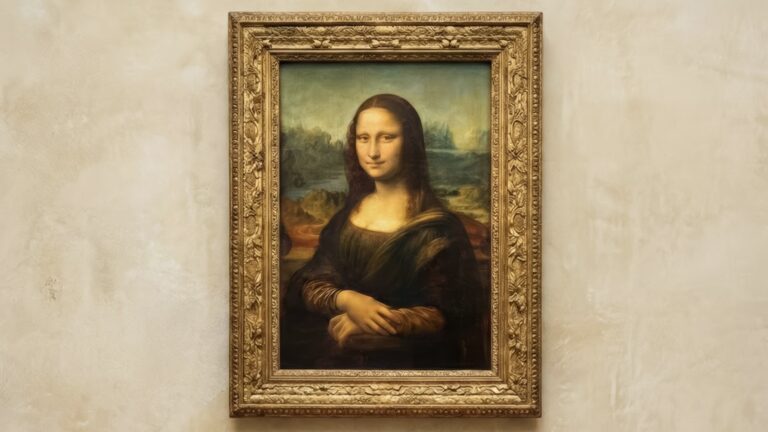
Francis also amassed one of the first great royal art collections in Europe. In 1516 he had invited the Italian master Leonardo da Vinci to his court. Leonardo brought with him three paintings one of which was the Mona Lisa. The king provided Leonardo with a pension and a residence at Clos Luce near Amboise where the artist spent his final years. After his death his works entered the royal collection helping establish the Louvre as a repository for the burgeoning canon of Renaissance art.
Thus the Louvre began to assume a new identity. It was no longer just a seat of power but a shrine to civilization’s achievements.
The Grand Design and the Grande Galerie
The momentum of Renaissance reform did not end with Francis I. Catherine de Medici the Florentine born queen continued palace construction and expanded the complex westward with the addition of the Tuileries Palace. Begun in 1564, the Tuileries would stand adjacent to the Louvre for centuries until its destruction in 1871 and serve as the preferred residence of French monarchs.
Yet it was Henry IV of France who realized what became known as the Grand Design a master plan to unify the Louvre and Tuileries into a single vast palace complex. From 1595 into the early seventeenth century Henry constructed the Grande Galerie along the Seine. Stretching nearly 450 meters, it was among the longest buildings in Europe at the time and was conceived both as a link between palaces and a space for displaying the royal collections.
Below the gallery’s lofty vaults art workshops flourished. Painters sculptors goldsmiths and clockmakers lived and worked in ateliers under royal patronage. What Henry built was not merely a passageway but a living workshop of creation a palace where culture was both displayed and made.
This integration of living arts into the fabric of the palace was unprecedented and in its ambition it foreshadowed the Louvre’s eventual role as an institution of universal culture.
Absolute Monarchy and a Changing Court
The seventeenth century saw the apex of absolute monarchy in France under Louis XIV. His chief minister Jean Baptiste Colbert sought prestige through monumental architecture. The Louvre’s east facade designed by a trio including Claude Perrault was constructed between 1667 and 1674 in a classicizing style that spoke of order rationality and imperial power. Its paired Corinthian columns and pedimented roofline became lasting icons of French classicism.
Yet Louis XIV’s reign marked a turning point. Disillusioned by Parisian uprisings and craving control over his court the king spent ever more energy on Palace of Versailles. In 1682 he moved his court there permanently. The Louvre once the seat of kings found itself behind the main theatre of power.
Without the constant presence of royalty the palace began a slow transformation. The halls that once hosted court ceremonials now housed academies and schools of art. Young painters copied the royal collections in the Grande Galerie. The Louvre’s role as center of French artistic education became more pronounced even as the brightness of monarchy faded within its walls.
Enlightenment Winds and the Birth of a Public Museum
By the eighteenth century the air in Paris was thick with Enlightenment thought. Philosophers like Denis Diderot and Jean Le Rond d’Alembert challenged old hierarchies and championed reason science and education for all. They argued that art too should be shared beyond the privileged few. Rather than hidden behind palace doors works of genius ought to be placed before the eyes of the public.
In 1750 Louis XV of France permitted the display of portions of the royal collection at the Luxembourg Palace for public access. Inspired by this modest opening plans for a permanent museum at the Louvre gained traction but political divisions and financial constraints delayed full realization.
Revolution and the Museum’s Opening
The outbreak of the French Revolution on 14 July 1789 shattered established orders. By 1791 the National Assembly declared the Louvre to be a repository for all monuments of art and science in France removing it from royal ownership. On 10 August 1793 the newly named Central Museum of the Arts opened its doors to the public. Former royal treasures were joined by confiscated noble collections and religious art seized during revolutionary turmoil.
The museum’s mission went beyond display. Curators and educators emphasized public instruction. Aspiring artists were allowed to copy masterpieces strengthening the museum’s role as a place of learning. The Louvre had become a shared cultural possession emblematic of a new political order that placed the nation above monarchy.
Empire and Cultural Ambition
During Napoleon Bonaparte’s rule military campaigns across Europe brought art and antiquities back to Paris further enriched from Italian city states and Egyptian lands. Napoleon briefly renamed the museum the Napoleon Museum matching empire with cultural glory.
After his defeat in 1815 many conquered works were returned to their homelands but the idea of the Louvre as a global collection endured. Paris had become in the museum’s halls a crossroads of world civilizations.
The Unified Palace and the Tuileries Tragedy
In the mid nineteenth century under Napoleon III the Louvre and its adjacent Tuileries Palace were unified into a continuous architectural ensemble. The architect Hector Lefuel forged this Nouveau Louvre with grand new facades corridors and galleries.
Yet in 1871 the Tuileries Palace was engulfed in flames during the Paris Commune. Its ruins were demolished in 1883 erasing one wing of royal history but cementing the Louvre’s identity as a museum institution rather than a palace of state.
Modern Transformation and the Glass Pyramid
By the late twentieth century the Louvre faced the challenge of welcoming ever greater audiences while preserving its heritage. In 1981 President Francois Mitterrand launched the Grand Louvre project to modernize and expand the museum. The centerpiece was a bold new glass pyramid designed by architect I. M. Pei. Completed in 1989 the structure served as a luminous portal into the underground visitor hall offering access to galleries in all wings and reframing the historic palace around a new hub of movement and light.
Though initially controversial the pyramid has become an icon of the museum itself marrying contemporary design with centuries of architectural history.
A Living Monument Today
Today the Louvre remains the world’s most visited museum safeguarding treasures from ancient civilizations to modern masterpieces. Its galleries are as diverse as its origins bridging epochs and cultures. Once a fortress against enemies then a stage for royal power and now a universal space for art and ideas the Louvre stands not only as a repository of beauty but as a chronicle of human aspiration.
Its stones have witnessed wars and revolutions kings and republics. Through every transformation the Louvre has remained a mirror reflecting not just the history of France but the evolving values of humanity itself. Whenever a visitor steps into its vast halls they enter not only a museum but eight hundred years of living history.
Note on images:
The images featured in this article are AI-generated visuals created solely to illustrate the content of the article. They have been produced as original visual expressions and do not reproduce, replicate, or derive directly from any third-party copyrighted material. No real individuals, protected artworks, or registered trademarks have been used without authorisation. These images are provided transparently, with full regard for applicable copyright and intellectual property rights.