

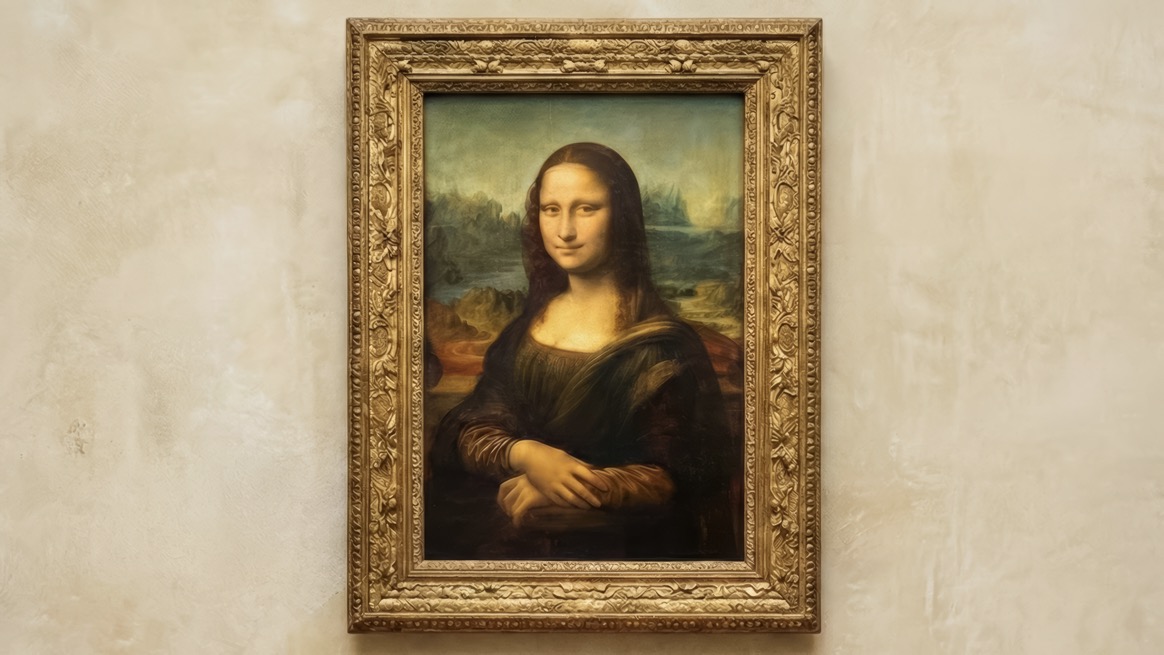
A Genius on Muleback: The True Story of How the Mona Lisa Came to France
Why is the Mona Lisa in France rather than Italy? It is one of the most fundamental questions in the history of the Louvre, and the answer leads us back to a single decision made by one of history’s greatest minds in the final years of his life.
In 1516, Leonardo da Vinci was in his mid-sixties when he received a passionate invitation from King Francis I of France. Francis was an ardent admirer of Renaissance art and a man who poured tremendous energy into luring the finest intellects of Italy to his kingdom. Leonardo accepted, and took up residence at the Château du Clos Lucé, near Amboise in the Loire Valley.
What makes the story remarkable is the journey itself. Despite his age, Leonardo chose to cross the formidable Alps on the back of a mule. Throughout that grueling trek, he kept three paintings with him at all times: the Mona Lisa, The Virgin and Child with Saint Anne, and Saint John the Baptist. These were the works he regarded as his supreme achievements.
The Mona Lisa had originally been commissioned by Francesco del Giocondo, a prosperous Florentine silk merchant, as a portrait of his wife, Lisa Gherardini. Yet Leonardo never delivered it. Begun around 1503, the painting received additions and refinements until almost the day he died. The reason is not difficult to understand: for Leonardo, this was never a finished product. It was a laboratory for the pursuit of his artistic ideals, and in particular a vehicle for exploring the technique known as sfumato, the art of blurring outlines to suggest layers of atmosphere and create shadows of extraordinary softness.

Four Thousand Gold Coins: A Legitimate Sale, Not a Theft
Leonardo died at the Château du Clos Lucé in 1519. The paintings he left behind passed to his student and executor Salaì, or possibly to Francesco Melzi. Francis I subsequently purchased them for a fair price, paying 4,000 gold florins for the Mona Lisa alone, an extraordinary sum by the standards of the day.
By every legal standard of the sixteenth century, this was an entirely proper transaction. The debate that periodically surfaces in later centuries, asking why the Mona Lisa is not in Italy, rests in part on the popular misconception that Napoleon stole it. He did not. Leonardo himself brought the painting to France, and it became the property of the French crown through a regular sale.
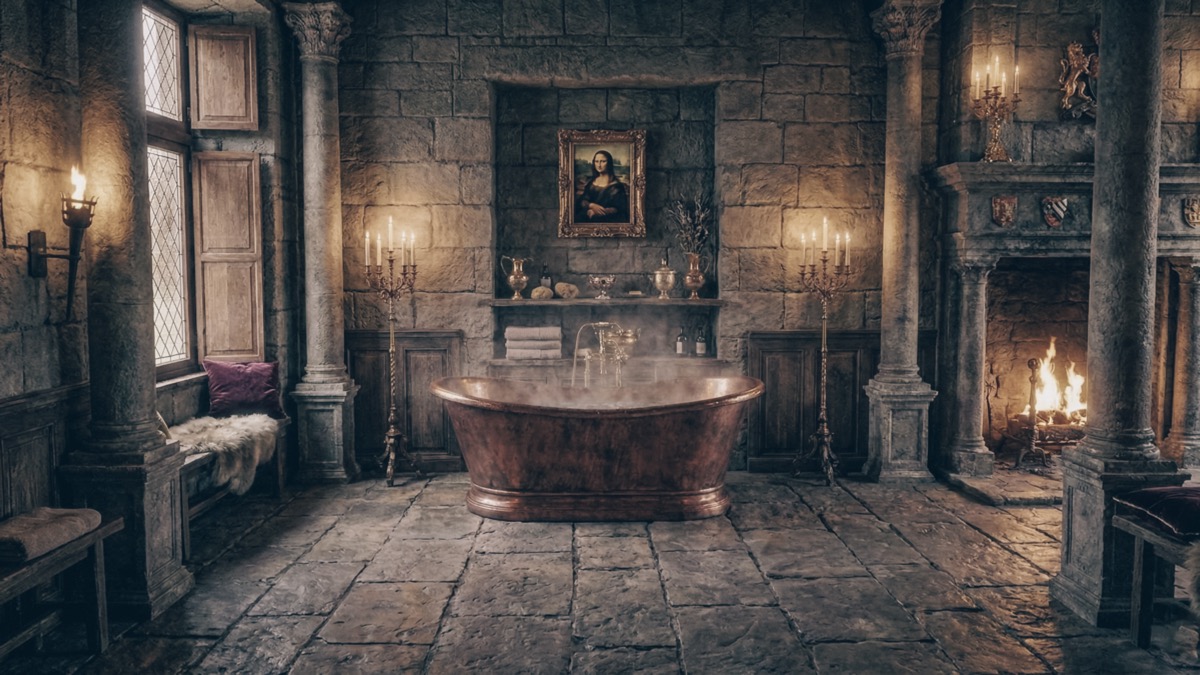
Once in royal hands, the Mona Lisa was displayed for a time in the bathroom suite of the Château de Fontainebleau, known as the appartement des bains, before Louis XIV had it moved to the Palace of Versailles. Then, in the upheaval of the French Revolution, the private collections of the royal family were declared the common property of the nation, and the Mona Lisa took its place as one of the defining treasures of the Louvre.
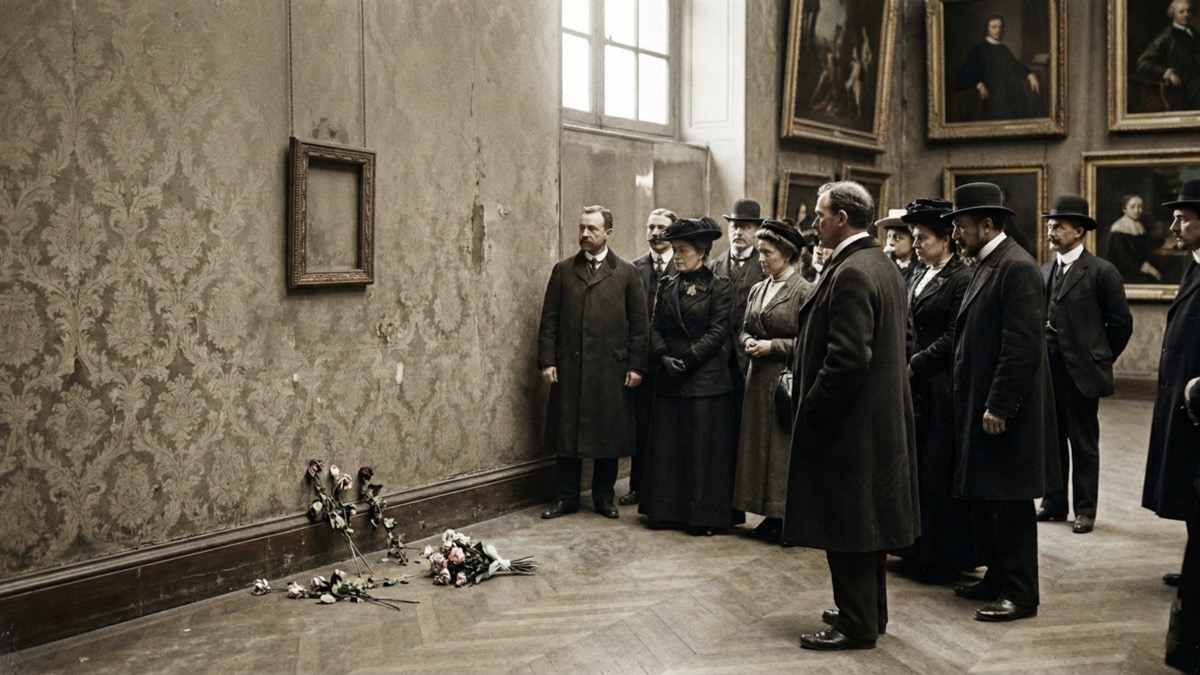
People Who Laid Flowers Before an Empty Wall: The Theft of 1911
Today the Mona Lisa is the most famous painting in the world. Yet for much of its history, while art historians recognized it as a Renaissance masterpiece, it inspired nothing like the mass obsession it commands today. That changed on August 21, 1911, when the painting was stolen.
The thief was Vincenzo Peruggia, an Italian craftsman who had worked at the Louvre installing protective glass on paintings. On a Monday, when the museum was closed to the public, he slipped inside wearing a white workman’s smock identical to those of the cleaning staff, lifted the painting from the wall, concealed it under his clothes, and walked out through the front entrance.
The theft was not discovered until close to noon the following Tuesday, when a painter named Louis Béroud arrived at the Salon Carré to make a copy of the picture and found an empty space where it should have been. The security arrangements at the Louvre were alarmingly inadequate: roughly 150 guards were responsible for a site of some fifteen acres, and there was no mechanism for securing paintings to the walls.
The investigation lost its way almost immediately. Police arrested the avant-garde poet Guillaume Apollinaire and, on the basis of his testimony, summoned the twenty-nine-year-old Pablo Picasso to appear before the examining magistrate. Picasso had come under suspicion because he had previously acquired ancient Iberian sculptures that had been stolen from the Louvre, using them as reference for his landmark work Les Demoiselles d’Avignon. Both men were ultimately cleared of any connection to the theft, but the episode speaks to the shockwaves the case sent through Parisian cultural life.
For more than two years, while the painting was missing, crowds came to the Louvre simply to stand before the empty wall. Some brought flowers. The newspapers wrote about the case day after day, embroidering the mystery of her smile with romantic speculation. The rumors were boundless: an international syndicate of criminals had taken her; she had been shipped to Brazil or Japan; a ransom demand was imminent. None of it was true.
The case was finally resolved in 1913, when Peruggia tried to sell the painting to an antique dealer in Florence and was arrested. He claimed that his motive had been patriotism, that he had wanted to return to Italy a treasure stolen by Napoleon. As already noted, the premise was false. The Mona Lisa had never been taken by Napoleon.
After a brief exhibition in Italy, the painting was returned to France amid scenes of jubilation. But the two years of absence had done something irreversible. What people had longed for was not primarily the painting’s beauty but the story of something lost and recovered. The theft transformed the Mona Lisa from an admired work of art into a sacred and mythologized icon, and that is what it has remained ever since.
The table below sets out the gap between what the media and public believed at the time and what was later established as fact.
| Subject | What People Believed | What Actually Happened |
|---|---|---|
| The perpetrator | An international criminal gang, or a German spy | A single individual, a former Louvre workman |
| The motive | A large ransom, or the creation of forgeries | Misguided patriotism, a desire to return the painting to Italy |
| The suspects | Pablo Picasso, the financier J.P. Morgan | Vincenzo Peruggia |
| The location | Brazil, Japan, or a secret underground vault | The thief's apartment in Paris, inside a trunk |
| The outcome | The painting was assumed to be lost forever | Found in Florence two years later, completely undamaged |
The Nazis Found an Empty Museum: Jacques Jaujard and the Great Evacuation
The outbreak of the Second World War brought the greatest crisis the Louvre had ever faced. The threat came from the Einsatzstab Reichsleiter Rosenberg, the Nazi task force established to systematically loot and appropriate the cultural treasures of occupied Europe. The man who protected thousands of works from this threat was Jacques Jaujard, deputy director of the national museums, whose foresight and organizational skill proved equal to the moment.
Jaujard had begun preparing long before the war started. As early as 1932 he had foreseen the possibility of another major European conflict and was quietly drawing up evacuation lists in secret. By the time of the Munich Crisis in 1938, he had already rehearsed the packing and transportation of the collections.
On August 25, 1939, with war only days away, Jaujard announced that the museum would close for repairs. He then mobilized every available person: museum staff, students, and even employees from neighboring department stores. Working without pause, they packed thousands of objects onto 203 trucks and sent them out of Paris one by one.
The operation was distinguished by a meticulous system of priorities. Each work was marked with a color-coded sticker indicating its importance. Yellow meant highly valuable; green indicated a major work; red was reserved for treasures of global significance. The Mona Lisa alone received three red stickers, a classification that no other object in the collections was given. Even the massive sculptures, including the Winged Victory of Samothrace and the Venus de Milo, were moved, with the help of specially built ramps and cranes.
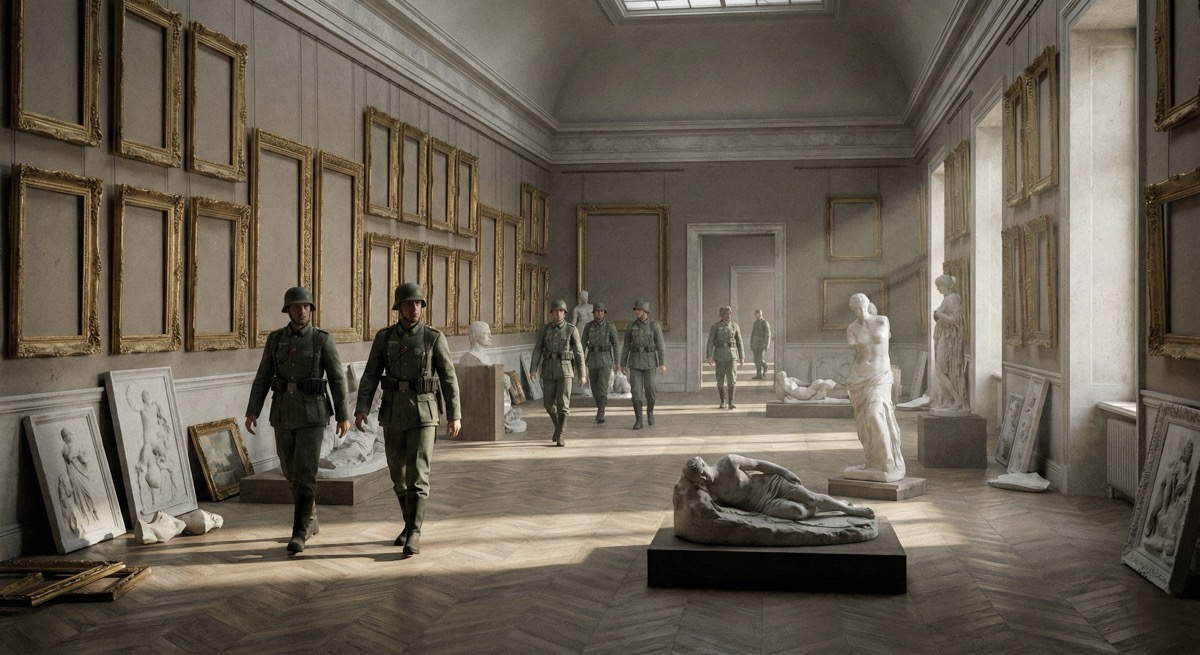
When German forces entered Paris unopposed in June 1940, what they found at the Louvre was a building emptied of everything that mattered. The galleries held only plaster copies and bare frames, placed there deliberately to mislead. Jaujard remained in Paris and dealt directly with Count Franz Wolff-Metternich, the officer in charge of the German Kunstschutz, or Art Protection unit. Metternich was a genuine art historian, not a fanatical ideologue, and he largely accepted Jaujard’s arguments, making no serious effort to locate and seize the collections hidden in the châteaux of the Loire Valley. The quiet understanding between these two men of learning saved a great many masterpieces.
The evacuated works moved six times in total as the military situation changed, passing through Chambord, Valençay, and ultimately the Musée Ingres in Montauban. When the war ended in 1945, every single object was returned to the Louvre without damage.
It was a victory of a particular kind, one that no army could have won. What Jaujard had defended could not be defended by force. He had used intelligence, preparation, and the shared instincts of two scholars on opposite sides of a war. His name is little known today, but the fact that the Mona Lisa still hangs in the Louvre owes as much to his preparations, which began thirteen years before the war ended, as to any other single cause.
What the Mona Lisa Tells Us About the Louvre
Tracing the journey of the Mona Lisa brings the full complexity of the Louvre into focus. The story begins with the personal decision of an aging genius crossing a mountain range on a mule. It continues through a legitimate royal purchase, a revolutionary transfer of ownership from crown to nation, a brazen theft that accidentally created the most famous artwork in the world, and a wartime rescue operation that required both institutional courage and quiet human decency.
The Louvre is not simply a storehouse for beautiful objects. It is a place where royal magnificence and the realities of daily life once coexisted in uncomfortable proximity, where the concept of public cultural heritage was born out of political upheaval, and where the intelligence and moral seriousness of individuals proved capable of defeating organized force. When visitors stand before the glass-encased smile, they are looking at something that carries all of these layers within it, whether they know it or not.
Note on images:
The images featured in this article are AI-generated visuals created solely to illustrate the content of the article. They have been produced as original visual expressions and do not reproduce, replicate, or derive directly from any third-party copyrighted material. No real individuals, protected artworks, or registered trademarks have been used without authorisation. These images are provided transparently, with full regard for applicable copyright and intellectual property rights.