On December 5, 2024, a centuries-old craft reached its global zenith. The traditional art of Japanese saké brewing—a meticulous symphony of rice, water, and the transformative power of kōji mold—was officially inscribed on UNESCO’s Intangible Cultural Heritage list. For the global gastronomic community, this was more than a formal recognition; it was a cultural coronation.
A decade earlier, washoku (Japanese cuisine) received the same honor, but at that time, the dishes were the stars. In 2026, the spotlight has finally shifted to the liquid that completes the table. This evolution has been felt nowhere more profoundly than in Paris, where saké has transitioned from a misunderstood “firewater” to a sophisticated peer of the finest grand crus.
The transformation of saké in the Parisian landscape is a study in cultural maturation. Not long ago, a Parisian seeking saké had a singular, somewhat uninspiring destination: the dusty shelves of an Asian grocery store. There, a few bottles might stand tucked between soy sauce and rice vinegar. The staff, though well-meaning, were rarely versed in the nuances of polishing ratios or yeast strains. Questions like “How does this pair with a Comté?” or “What is the difference between a Ginjō and a Daiginjō?” were often met with polite shrugs.
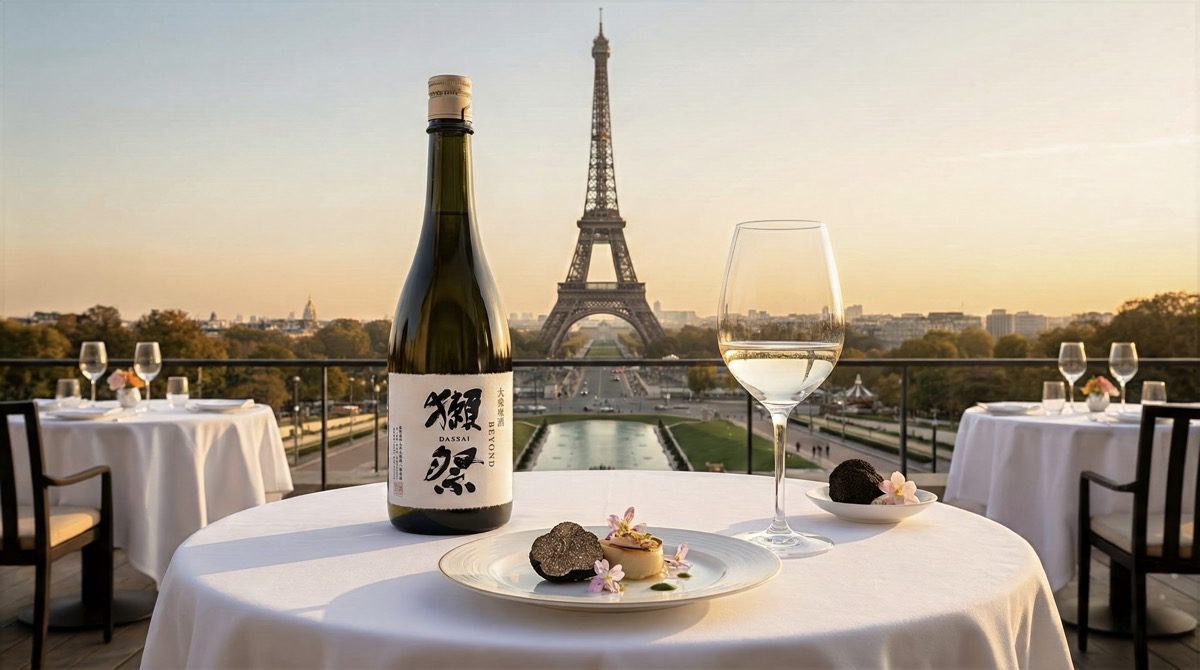
Today, the map of Paris has been rewritten. Elegant boutiques devoted entirely to saké—such as those found in the 6th and 15th Arrondissements—now treat these bottles like high jewelry. Here, sleek glass bottles with minimalist labels stand in temperature-controlled rooms alongside Burgundy and Bordeaux. The staff are often certified sommeliers who can discuss a brewery’s terroir with the same precision one would apply to a Chablis. Saké has stepped out of the “exotic grocery” shadow and into the light of professional gastronomy.
The greatest hurdle in saké’s journey was a long-standing “image problem” rooted in a case of mistaken identity. Until the early 2000s, many “Japanese” restaurants in Paris—often run by non-Japanese owners—offered a complimentary glass of “saké” at the end of the meal.
In reality, this liquid was almost never Japanese saké. It was Chinese Baijiu, a high-proof distilled spirit (often 40–60% ABV) made from sorghum or rice. While premium Baijiu is a masterpiece of complexity, the versions common in Paris were fiery, high-ester “firewaters” that left a persistent, misleading impression. For countless Parisians, this was their first and only experience of “saké,” leading them to believe it was a harsh digestif taken as a shot, rather than a delicate companion to food.
For the professional palate, the differences are chemical and fundamental:
Saké is a brewed beverage (like wine or beer) with an ABV of 15–20%, characterized by umami and subtle esters.
Baijiu is a distilled spirit, characterized by bold, funky aromas and a high alcohol burn.
To understand the modern saké renaissance, one must look past the liquid and into the cellular structure of the rice grain. Unlike wine grapes, where sugars are readily available for fermentation, rice is a fortress of starch. The key to unlocking its elegance lies in Seimai (Rice Polishing).
A grain of saké rice (Saka Mai) contains an outer shell of proteins, lipids, and vitamins. If left intact, these elements produce “zatsumi”—heavy, off-flavors that cloud the palate. The goal of premium brewing is to reach the Shinpaku (the White Heart), the pure starchy core of the grain.
Junmai/Honjozo: Roughly 70% of the grain remains. These are earthy, cereal-forward, and robust.
Ginjo: At least 60% remains.
Daiginjo: 50% or less of the grain remains. At this level of refinement, the saké begins to exhibit Ginjo-ka—ethereal aromas of melon, green apple, and anise.
In the specialized boutiques of Paris, a bottle of ultra-premium Junmai Daiginjo polished to 23% might retail for €158. At this price point, consumers are paying for the technical mastery required to shave away nearly 80% of each grain without shattering it, a process that can take over 100 hours of precision milling.
For the professional sommelier, the most fascinating aspect of saké is its fermentation kinetics. It is the most complex brewing process in the world, known as Heiko Fukushiki Hakko (Parallel Multiple Fermentation).
Unlike beer, where starch is converted to sugar and then fermented in separate steps, saké performs these actions simultaneously in a single vat. The Kōji-kin (Aspergillus oryzae) breaks down starch into glucose while the Kobo (Yeast) converts that glucose into alcohol. Managing this balance is the ultimate test of a Tōji (Master Brewer). If the “sugar-making” outpaces the “alcohol-making,” the yeast becomes overwhelmed; if it lags, the fermentation stalls. This delicate equilibrium allows saké to reach a natural alcohol content of nearly 20%—the highest of any non-distilled beverage.
If rice is the canvas, the yeast is the architect of the aroma. In 2026, the selection of yeast strains is the most critical technical decision for a brewery targeting the French palate. The Brewing Society of Japan maintains and distributes the standardized lineage of strains (known colloquially as Kyokai yeasts) that define specific sensory profiles:
No. 7 (The Masumi Strain): Known for its robustness. It creates a mellow, umami-rich profile that pairs beautifully with aged Comté or roasted poultry.
No. 9 (The Kumamoto Strain): The progenitor of the “Ginjo style.” It produces high levels of Isoamyl Acetate, yielding the iconic aromas of banana and melon.
No. 1801: The modern powerhouse. It generates intense Ethyl Caproate, resulting in bright notes of green apple and white flowers. A bottle utilizing 1801, such as a high-end Junmai Ginjo, often costs around €95 in Paris.
No. 77: A favorite in 2026 for its high malic acid production. Its tart, “wine-like” acidity allows it to cut through the richness of Sole Meunière or buttery French sauces.
The Parisian obsession with terroir has led to a deep dive into rice varietals. The dialogue between the soil and the grain dictates the “verticality” or “breadth” of the saké.
Yamada Nishiki (The King of Rice): Primarily from the “Special A” districts of Hyogo, this grain is the pinnacle of precision. Its heart is centered and stable, allowing for extreme polishing. It produces a saké that is crystalline, elegant, and focused—the “Chardonnay” of the saké world.
Omachi (The Heritage Grain): A wild, non-crossbred variety from Okayama. It is “softer” and more porous, meaning it dissolves easily in the vat. This high solubility creates a strong fermentation that results in a broader, more muscular palate with earthy, herbal, and spicy notes. It is the darling of sommeliers looking to pair saké with game meats or truffle-based dishes.
The most radical development in the 2020s has been the emergence of “French Terroir Saké.” Local pioneers like WAKAZE have upended the tradition by brewing in the heart of the Paris region.
By using organic Camargue rice and the mineral-rich, “hard” water of Paris, they have created a profile that differs fundamentally from the “soft” water brews of Kyoto. Hard water fuels the yeast, creating a more structured, acid-driven saké. This hybrid identity—Japanese technique meeting French geology—has made saké a local craft, not just a distant import.
Spotlight: Salon du Saké 2025
For those looking to immerse themselves in this culture, the Salon du Saké remains the premier gateway in Europe. Having grown from a niche gathering to a major fixture on the Paris food calendar, the 2025 edition proved that sake’s popularity is no longer a trend, but a permanent shift in the zeitgeist.
Dates: October 4 – 6, 2025 (Annual)
Venue: New Cap Event Center, 15th Arrondissement, Paris.
Scale: Over 600 varieties of sake, shōchū, and Japanese spirits across 1,500 square meters.
Admission:
1-Day Pass: €25
2-Day Pass: €40
Every autumn in Paris, a corner of the city turns into a gateway to Japan’s drinking culture.
The Salon du Saké, Europe’s largest celebration of sake and related beverages, brings together sake breweries along with shōchū, umeshu, green tea, wagashi, traditional crafts, and even travel experiences.
For three days, the event becomes a living showcase of Japan’s flavors and traditions in one place.
The journey of saké in France has evolved from a mislabeled, high-proof digestif to a pinnacle of technical brewing. It is a drink that demands intellectual engagement, rewarding the curious with a complexity that rivals any grand cru. As the world celebrates its UNESCO status, the glass of saké on a Parisian table is a sign of a diner who understands the sophisticated intersection of microbiology, geology, and art.